
▌Low curvature combined with high amorphization improves SERS sensitivity of semiconducting Rh–Se mesoporous nanospheres toward non-adsorbing resistant pollutants
低曲率結合高度非晶化提升半導體 Rh–Se 介孔奈米球對難吸附汙染物的 SERS 靈敏度
Yunqing Kang*, Olga Guselnikova*, Lei Fu, Norman C.-R. Chen, José Julio Gutiérrez Moreno, Joel Henzie, Yuqi Guo, Xiangyang Liu, Yingji Zhao, Wei-Hsiang Huang, Min-Hsin Yeh, Yagmur Tanis, Markus Valtiner, Stanislav Ježek, Jun Zhou, Yusuke Asakura, Kevin C.-W. Wu and Yusuke Yamauchi*
https://doi.org/10.1038/s41467-026-75365-2
SEED Member: Min-Hsin Yeh, Wei-Hsiang Huang
Major Contributions
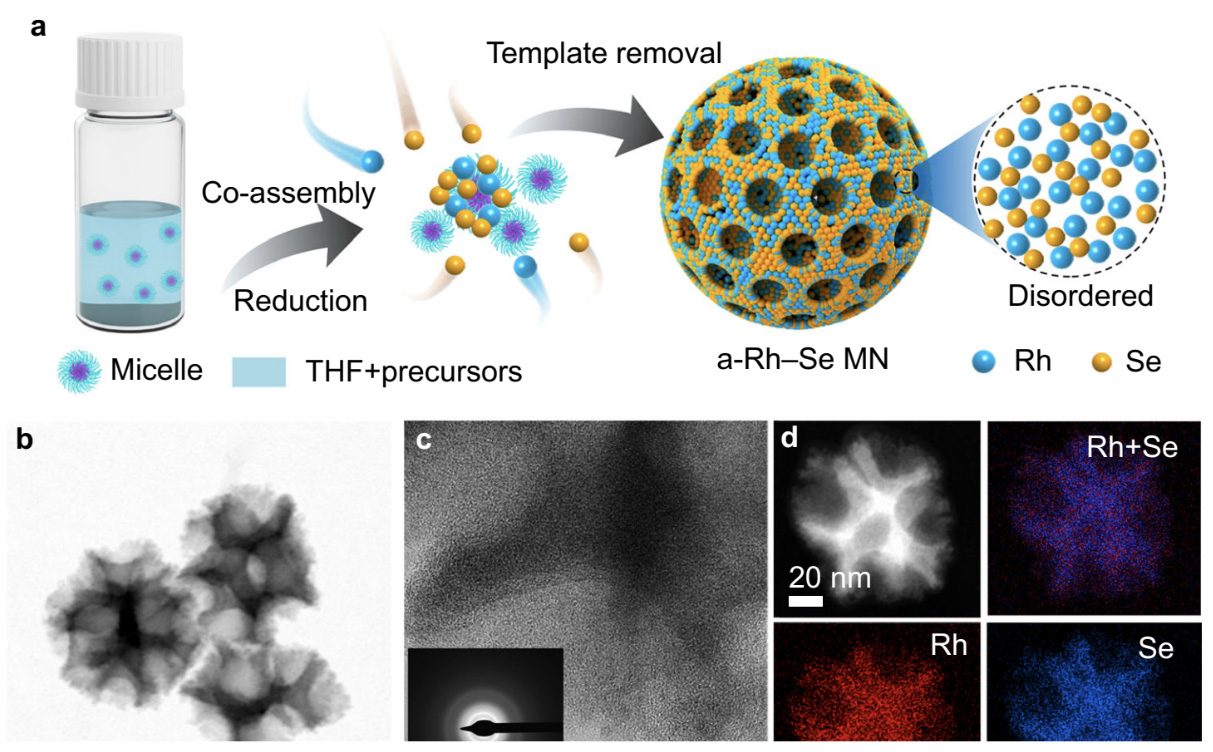
1. Developed a one-step micellar self-assembly reduction method to produce amorphous semiconducting Rh–Se mesoporous nanospheres (a-Rh–Se MNs), overcoming the difficulty of homogeneously selenizing noble metals.
2. Systematically tuned composition, surface curvature and crystallinity; a-Rh–Se with low curvature and high amorphization detects non-adsorbing, low-polarizability analytes such as hexachlorobenzene (LOD 6.2 × 10⁻⁹ M), anthracene and PTFE microplastics, even in wastewater.
3. Experiments and DFT show that co-modulating curvature and amorphization tunes the d-band center and work function to promote resonant charge transfer, overturning the paradigm that prioritizes high-surface-area substrates.
主要貢獻
1. 開發一步式微胞自組裝還原法,製備非晶半導體 Rh–Se 介孔奈米球(a-Rh–Se MNs),克服貴金屬難以均勻硒化的問題。
2. 系統調控組成、表面曲率與結晶度;低曲率且高度非晶的 a-Rh–Se 可偵測難吸附、低極化率的分析物,如六氯苯(偵測極限 6.2 × 10⁻⁹ M)、蒽與 PTFE 微塑膠,在廢水中也適用。
3. 實驗與 DFT 計算顯示,同時調控曲率與非晶化可改變 d 帶中心與功函數、促進共振電荷轉移,推翻「表面積越大越好」的傳統觀點。