
▌Mn-Mediated Reduction Coupling Mechanism Stabilizes Anion Redox Chemistry Toward High-Performance P2-Type Na-Layered Oxide Cathodes
錳媒介還原耦合機制穩定陰離子氧化還原化學,實現高性能 P2 型鈉層狀氧化物正極
Haitao Ren, Bing Wang*, Jiedong Li, Xiaogang Wang, Zhiwei Hu, Jun Ma*, Chih-Wen Pao, Wei-Hsiang Huang, Chang-Yang Kuo, Chien-Te Chen, Jingwen Zhao, Guoli Lu, Xianfen Wang* and Guanglei Cui*
https://doi.org/10.1002/aenm.71062
SEED Member: Wei-Hsiang Huang
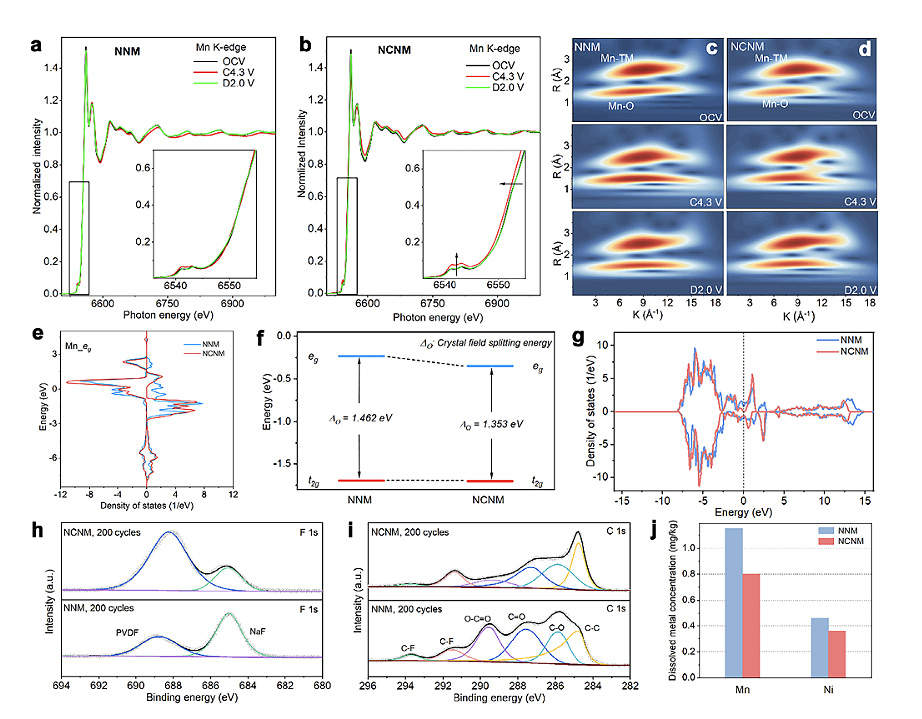
Charge compensation, electronic structure and interfacial stability of the cathodes
Major Contributions
1. Unveiled a Mn-mediated reductive coupling mechanism, activated by Ca doping in P2-Na₀.₆₄Ca₀.₀₃Ni₀.₃₃Mn₀.₆₇O₂, in which uncommon electron transfer from oxygen to Mn enhances the reversibility and kinetics of anionic redox in sodium-ion battery cathodes.
2. Showed by synchrotron XAS and DFT that Ca incorporation lowers the crystal-field splitting of Mn 3d orbitals and facilitates charge transfer from O 2p to Mn eg orbitals at high voltage, suppressing irreversible lattice oxygen loss.
3. Ca²⁺ pillars in the Na layers inhibit the P2–O2 phase transition and reduce lattice strain, giving 80% capacity retention after 800 cycles at 1.0 C with a high cutoff voltage of 4.3 V.
主要貢獻
1. 揭示由鈣摻雜啟動的錳媒介還原耦合機制:在 P2-Na₀.₆₄Ca₀.₀₃Ni₀.₃₃Mn₀.₆₇O₂ 正極中,電子由氧轉移至錳離子,提升鈉離子電池陰離子氧化還原的可逆性與動力學。
2. 同步輻射 X 光吸收光譜與 DFT 計算顯示,鈣的引入降低 Mn 3d 軌域的晶體場分裂能,促進高電壓下 O 2p 向 Mn eg 軌域的電荷轉移,抑制不可逆的晶格氧流失。
3. 位於鈉層的 Ca²⁺ 作為剛性支柱,抑制 P2–O2 相變並降低晶格應變;在 4.3 V 高截止電壓、1.0 C 下循環 800 圈後仍保有 80% 容量。