
▌Metal-modified covalent organic frameworks for photocatalytic CO₂ reduction toward a circular economy: Novel structural designs to high-value renewable fuels
金屬修飾共價有機框架用於光催化 CO₂ 還原以邁向循環經濟:從新穎結構設計到高價值再生燃料
Balvinder Kaur, Parul Rana, Vatika Soni, Sonu, Pardeep Singh, Savas Kaya, Chechia Hu, Aftab Aslam Parwaz Khan, Van-Huy Nguyen* and Pankaj Raizada*
https://doi.org/10.1016/j.ccr.2026.218381
SEED Member: Chechia Hu
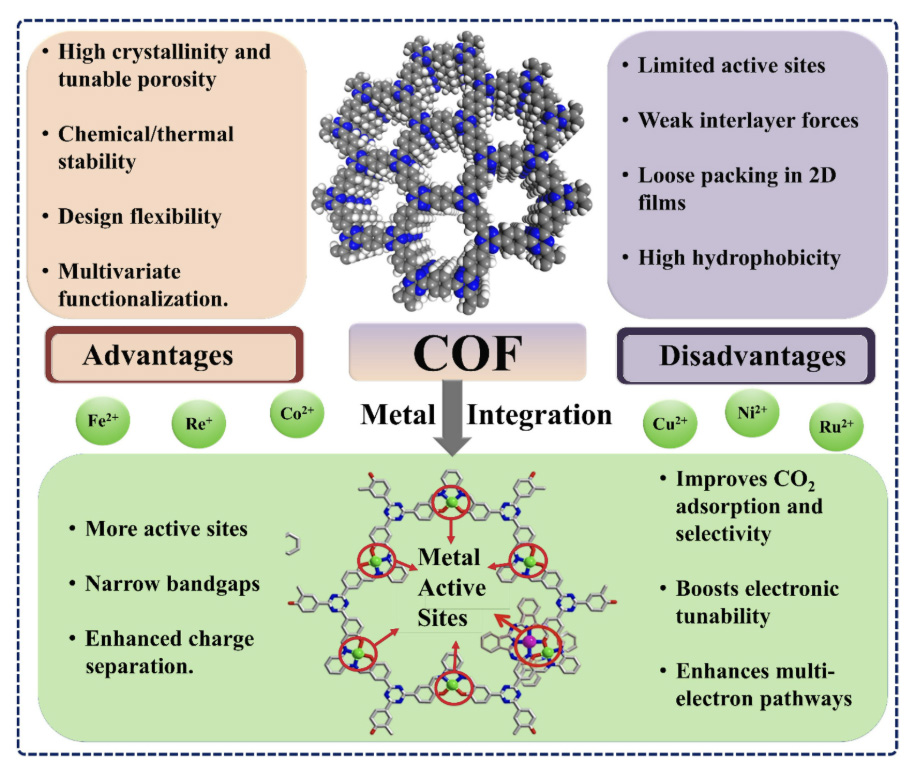
Pristine COFs vs. metal-modified COFs: property regulation by metal integration
Major Contributions
1. Reviewed recent advances in metal-modified covalent organic frameworks (MCOFs) for photocatalytic CO₂ reduction, analyzing how metal centers control electronic structure, charge transfer and reaction selectivity.
2. Explained how single-site metal atoms, metal clusters and bimetallic sites enable CO₂ adsorption, stabilize key intermediates (*COOH and *CO) and suppress competing hydrogen evolution, including asymmetric dual-metal sites for C–C coupling.
3. Systematically compared pre-synthetic, in situ and post-synthetic metal introduction in terms of coordination environment and framework crystallinity, and outlined challenges and data-driven design directions.
主要貢獻
1. 回顧金屬修飾共價有機框架(MCOFs)用於光催化 CO₂ 還原的最新進展,分析金屬中心如何控制電子結構、電荷轉移與反應選擇性。
2. 說明單原子金屬、金屬團簇與雙金屬位點如何促進 CO₂ 吸附、穩定關鍵中間物(*COOH、*CO)並抑制競爭的析氫反應,也涵蓋可促成 C–C 耦合的不對稱雙金屬位點。
3. 系統比較合成前、原位與合成後三種金屬引入方式對配位環境與框架結晶度的影響,並提出現有挑戰與數據驅動的設計方向。