

▌Block copolymer architectures with poly(ε-caprolactone) for modulating interactions to enhance selectivity and stability of semiconducting single-walled carbon nanotube dispersions
含聚(ε-己內酯)的嵌段共聚物結構用於調節相互作用,以增強半導體單壁碳奈米管分散液的選擇性和穩定性。
Y. H. Huang, P. H. Wu, Y. S. Lu, Y. C. Lin, C. Y. Huang, C. Y. Yu, Z. W. Cyue, J. C. Lin, C. C. Chang, S. S. Li*, B. J. Hwang, C. W. Chen* and D. Y. Wang*
https://doi.org/10.1016/j.carbon.2026.121250
SEED Member: B. J. Hwang, D. Y. Wang
Major Contributions
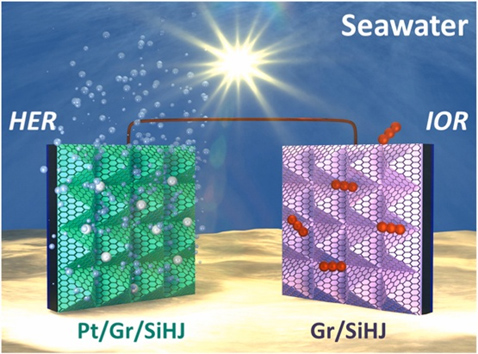
1. Atomic layer graphene (ALG) serves dual functions as a charge transport interlayer and catalytic interface, enabling the iodide oxidation reaction (IOR) as a thermodynamically favorable alternative anode reaction to OER in photoelectrochemical (PEC) seawater splitting.
2. The lower thermodynamic potential of IOR coupled with ALG-modified photoanodes enables bias-free PEC operation, overcoming the large external bias requirement that limits conventional PEC water splitting systems.
3. ALG integration significantly improves photocurrent density, charge separation efficiency, and long-term operational stability under realistic seawater conditions, establishing a dual-functional graphene strategy for solar-driven hydrogen production.
主要貢獻
1. 原子層石墨烯(ALG)發揮電荷傳輸夾層與催化界面的雙重功能,使碘化物氧化反應(IOR)成為光電化學(PEC)海水分解中熱力學上有利的替代陽極反應,取代析氧反應。
2. IOR 較低的熱力學電位結合 ALG 改性光陽極實現無偏壓 PEC 操作,克服限制傳統 PEC 水分解體系的大外加偏壓需求。
3. ALG 整合顯著改善真實海水條件下的光電流密度、電荷分離效率與長期操作穩定性,確立雙功能石墨烯策略用於太陽能驅動產氫。