

▌Directional Ion Migration Enables Precise Heterointerface Optimization for High-Temperature CO2Electrolysis
定向離子遷移實現高溫 CO₂ 電解之精確異質界面優化
S. Liu, R. Qiao, M. Yang, W. Feng, B. Xiong, D. Feng, G. Yang*, W. H. Huang, M. H. Yeh, C. W. Pao, Z. Hu, X. Xu, W. Cao*, R. Ran, W. Zhou and Y. Zhu*
https://doi.org/10.1021/jacs.5c21833
SEED Member: M. H. Yeh, W. H. Huang
Major Contributions
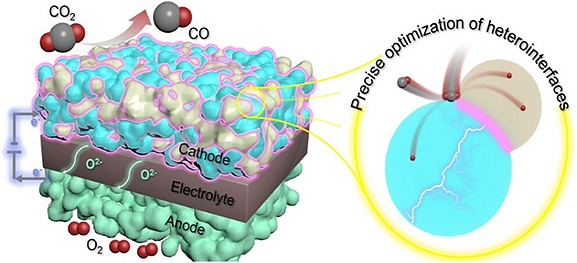
1. Directional Ru ion migration from Ru₀.₀₅Ce₀.₉₅O₂ fluorite to Sr₂Fe₁.₅Mo₀.₅O₆-δ perovskite heterointerfaces during thermal treatment precisely tunes oxygen vacancy concentration and Fe electronic environment, markedly enhancing O²⁻/e⁻ conductivity and CO₂RR activity.
2. The SFM-005Ru@CeO₂ electrode achieves an ultrahigh CO₂ electrolysis current density of 3.80 A cm⁻² at 1.5 V and 800°C—superior to all previously reported electrodes—with excellent 200 h stability at 750°C under 1.6 A cm⁻².
3. This work establishes directional ion migration as a universal strategy for precise heterointerface engineering in composite oxide electrode systems for solid oxide electrolysis cells.
主要貢獻
1. 熱處理期間 Ru 離子從 Ru₀.₀₅Ce₀.₉₅O₂ 螢石相定向遷移至 SFM 鈣鈦礦異質界面,精確調控氧缺陷濃度與 Fe 電子環境,顯著增強 O²⁻/e⁻ 導電性與 CO₂RR 活性。
2. SFM-005Ru@CeO₂ 電極在 1.5 V、800°C 下實現 3.80 A cm⁻² 的超高 CO₂ 電解電流密度,超越所有已報道電極,並在 750°C、1.6 A cm⁻² 下展現 200 小時穩定性。
3. 此研究確立定向離子遷移為固體氧化物電解槽複合氧化物電極系統精確異質界面工程的通用策略。