

▌Design of interpenetrating-polymer network electrolytes for speedy Li+ transport and uniform Li-deposition in solid-state lithium batteries
設計互穿高分子網絡電解質以實現固態鋰電池中快速 Li⁺ 傳輸與均勻鋰沉積
H. T. T. Nguyen, L. T. Wu, M. L. Nguyen, C. W. Hsu, J. C. Jiang, Y. L. Lee, J. S. Jan, M. Finsterbusch, O. Guillon and H. Teng*
https://doi.org/10.1016/j.ensm.2025.104780
SEED Member: J. C. Jiang
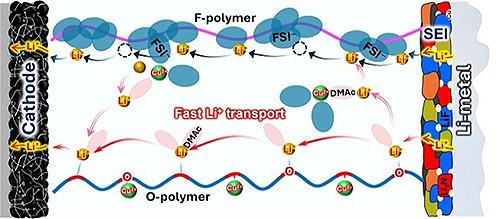
Major Contributions
1. Interpenetrating polymer network (IPN) electrolytes combining PEO and PVdF-type networks are designed to provide interconnected Li⁺ transport pathways, achieving high ionic conductivity and Li⁺ transference number in solid-state lithium batteries at moderate temperatures.
2. The IPN architecture regulates local Li⁺ flux distribution at the Li-metal anode interface, enabling uniform Li deposition and suppressing dendrite growth for improved Coulombic efficiency and cycling stability.
3. Li||IPN electrolyte||cathode cells exhibit enhanced rate capability and long-term cycling performance, demonstrating the effectiveness of network polymer design for addressing both conductivity and interfacial challenges in practical SSLBs.
主要貢獻
1. 設計結合 PEO 與 PVDF 型網絡的互穿高分子網絡(IPN)電解質,提供相互連通的 Li⁺ 傳輸路徑,在中溫條件下實現固態鋰電池高離子導電率與 Li⁺ 遷移數。
2. IPN 架構調控鋰金屬陽極界面的局域 Li⁺ 通量分佈,實現均勻鋰沉積並抑制枝晶生長,提升庫侖效率與循環穩定性。
3. Li||IPN 電解質||正極電池展現增強的倍率性能與長期循環性能,驗證網絡高分子設計同時解決實際固態鋰電池導電性與界面挑戰的有效性。