

▌Host–guest mediated structural tuning of selenium sites in-plane structure of metallic phase tungsten diselenide for enhanced hydrogen production
主客體介導的金屬相二硒化鎢面內硒位點結構調控用於增強產氫性能
W. B. Dilebo, C. Y. Chang, H. G. Edao, C. C. Chang, K. Lakshmanan, E. A. Moges, F. T. Angerasa, C. B. Guta, L. T. Kitaba, B. D. Bejena, D. D. Alemayehu, M. C. Tsai*, W. N. Su* and B. J. Hwang*
https://doi.org/10.1016/j.apcatb.2025.126340
SEED Member: B. J. Hwang, W. N. Su, M. C. Tsai
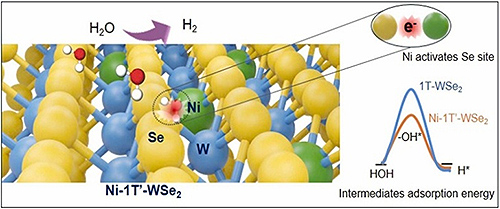
Major Contributions
1. A host–guest strategy structurally tunes selenium sites within the in-plane lattice of metallic-phase (1T) tungsten diselenide (WSe₂), modifying local coordination and d-band structure to optimize hydrogen adsorption free energy for enhanced HER.
2. The host–guest interaction stabilizes the metallic 1T phase and introduces controlled Se-site distortions, synergistically improving intrinsic catalytic activity and long-term stability under acidic and alkaline conditions.
3. The engineered metallic-phase WSe₂ achieves significantly improved HER performance compared to pristine WSe₂, offering insights into phase-engineering and in-plane heteroatom tuning as strategies for designing 2D electrocatalysts.
主要貢獻
1. 採用主客體策略調控金屬相(1T)二硒化鎢(WSe₂)面內晶格中的硒位點結構,改變局域配位與 d 帶結構,優化氫吸附自由能以增強 HER 性能。
2. 主客體相互作用穩定金屬 1T 相並引入受控的 Se 位點畸變,協同提升酸鹼條件下的本徵催化活性與長期穩定性。
3. 工程化金屬相 WSe₂ 相比純 WSe₂ 展現顯著改善的 HER 性能,為相工程與面內雜原子調控設計二維電催化劑策略提供見解。