

▌Anode-Free Batteries: Pioneering Energy Storage Revolution
無負極電池:開創能源儲存革命
Y. Nikodimos*, K. N. Shitaw, T. M. Hagos, T. I. Yeh, Y. C. Huang, C. L. Hsieh, H. H. Su, W. N. Su* and B. J. Hwang*
https://doi.org/10.1021/acs.chemrev.5c00533
SEED Member: B. J. Hwang, W. N. Su, Y. Nikodimos
Major Contributions
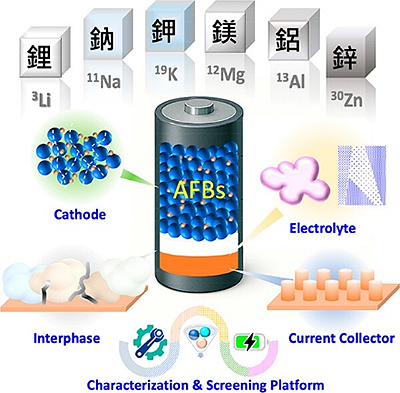
1. This review comprehensively analyzes the fundamental phenomena of anode-free batteries (AFBs), covering nucleation, growth, dendrite formation, dead metal regeneration, morphological evolution, and electrolyte decomposition during metal plating/stripping, providing a systematic mechanistic foundation.
2. The scope extends beyond lithium to cover anode-free sulfur, sodium, potassium, zinc, magnesium, aluminum, and all-solid-state batteries, with unique challenges and innovative solutions catalogued for each system.
3. AFBs are highlighted as a platform technology for probing interfacial phenomena—visualizing deposition, quantifying dead metal, and rapidly screening electrolytes—positioning them as pivotal for next-generation high-energy-density storage.
主要貢獻
1. 本綜述全面分析無負極電池(AFBs)的基礎現象,涵蓋金屬電鍍/剝離過程中的成核、生長、枝晶形成、廢死鋰再生、形貌演化與電解質分解,提供系統性機制基礎。
2. 範疇超越鋰,涵蓋無負極硫、鈉、鉀、鋅、鎂、鋁及全固態電池體系,詳述各體系的獨特挑戰與創新解決方案。
3. 強調 AFBs 作為探究界面現象的平台技術——可視化沉積、定量廢死金屬及快速篩選電解液——定位其為下一代高能量密度儲能的關鍵技術。