

▌Ceramic-Induced Polymer Reconstruction to Promote Li+ Migration in Electrolyte and Interphase Layers of Solid-State Lithium Batteries
陶瓷誘導高分子重構以促進固態鋰電池電解質與界面層中的 Li⁺ 傳輸
C. H. Wu, L. T. Wu, W. H. Wu, Y. Schneider, B. C. Zhao, J. C. Jiang, Y. C. Lin, P. Y. Huang, Y. C. Lee, W. T. Chuang, Y. S. Sun, Y. L. Lee, J. S. Jan, F. H. Richter and H. Teng*
https://doi.org/10.1002/adfm.202523316
SEED Member: J. C. Jiang
Major Contributions
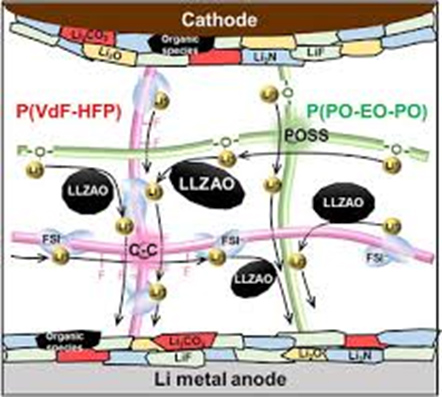
1. Garnet ceramic activates DMAc solvent to mediate PVdF crosslinking and β-PVdF formation, dispersing FSI⁻ clusters and establishing dual Li⁺ transport pathways (ether-linkage hopping on PEO and FSI⁻ clusters on PVdF).
2. The resulting gn-IPNE achieves ionic conductivity of 1.9 mS cm⁻¹ and Li⁺ transference number of 0.68 at 30°C through synergistic ceramic-polymer-solvent interactions.
3. SSLBs using gn-IPNE demonstrate 86% capacity retention over 500 cycles (Li||LFP) and 90% over 200 cycles (Li||NMC811), validating the ceramic-induced reconstruction strategy for practical solid-state batteries.
主要貢獻
1. 石榴石型陶瓷活化 DMAc 溶劑以介導 PVDF 交聯與 β-PVDF 形成,分散 FSI⁻ 簇並建立雙 Li⁺ 傳輸路徑(PEO 上的醚鍵躍遷及 PVDF 上的 FSI⁻ 簇路徑)。
2. 所製備的 gn-IPNE 透過陶瓷-高分子-溶劑協同相互作用,在 30°C 下實現 1.9 mS cm⁻¹ 離子導電率與 0.68 的 Li⁺ 遷移數。
3. 採用 gn-IPNE 的固態鋰電池在 Li||LFP 體系中 500 次循環後保持 86% 容量,在 Li||NMC811 體系中 200 次循環後保持 90%,驗證陶瓷誘導重構策略的實用性。