

▌Origins of lithium inventory reversibility with an alloying functional layer in anode-free lithium metal batteries
無陽極鋰金屬電池中合金化功能層之鋰庫存可逆性起源
Lennart Wichmann, Shi-Kai Jiang, Johannes Helmut Thienenkamp, Marvin Mohrhardt, Bing Joe Hwang, Martin Winter & Gunther Brunklaus*
https://doi.org/10.1038/s41467-025-62289-6
SEED Member: Bing Joe Hwang
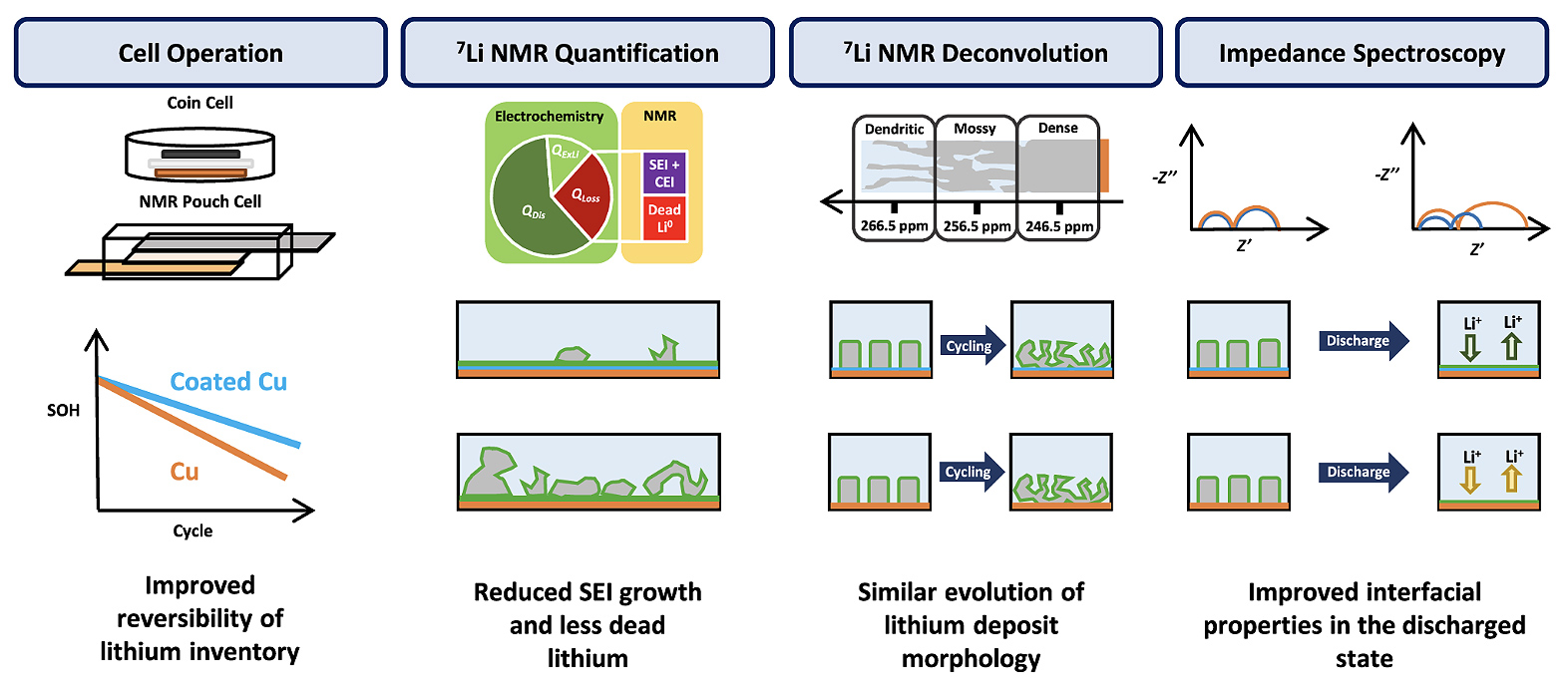
Schematic depiction of the utilized methods and main findings.
Major Contributions
1.Development of Quantification Protocol: Establishment of an in situ 7Li NMR spectroscopy methodology tailored for NMC-based anode-free pouch cells, enabling the precise deconvolution of capacity losses into dead lithium formation and interphase consumption.
2.Mechanistic Elucidation: Revelation that the enhanced reversibility provided by Sn-based alloying layers stems from improved interfacial transport towards the end of lithium dissolution, driven by an irreversible Li22Sn5 phase, rather than the suppression of high-surface-area morphological growth.
3.Performance Enhancement Insight: Demonstration that the functional coating significantly mitigates the accumulation of electronically insulated (dead) lithium deposits and accelerates interphase stabilization, effectively extending the cycle life of anode-free batteries operating with localized high-concentration electrolytes.
主要貢獻
1.量化協議的開發:建立專用於 NMC 基無負極軟包電池的原位 7Li NMR 光譜方法,精確將容量損失解析為死鋰形成與界面消耗。
2.機制闡明:揭示錫基合金層所提供的可逆性增強,源於不可逆 Li22Sn5 相在鋰溶解末期對界面傳輸的改善,而非抑制高表面積沉積物(如枝晶)的生長。
3.性能提升解析:證實該功能塗層顯著減少了電子絕緣(死)鋰沉積物的堆積並加速了界面的穩定化,有效延長了使用局部高濃度電解液之無負極電池的循環壽命。