

▌Strategic design and mechanistic unveiling of Ni-based S-scheme heterojunctions for efficient CO2 photoreduction to C1 products: Coordination chemistry, spectroscopic evidence, and future directions
鎳基 S-scheme 異質結用於高效 CO₂ 光還原至 C1 產物的策略設計與機制解析:配位化學、光譜證據與未來方向
Malhotra, Monika, Pardeep Singh, Quyet Van Le, Aftab Aslam Parwaz Khan, Konstantin P. Katin, Savaş Kaya, Chechia Hu, Van-Huy Nguyen, and Pankaj Raizada.
https://doi.org/10.1016/j.ccr.2025.217179
SEED Member: Chechia Hu
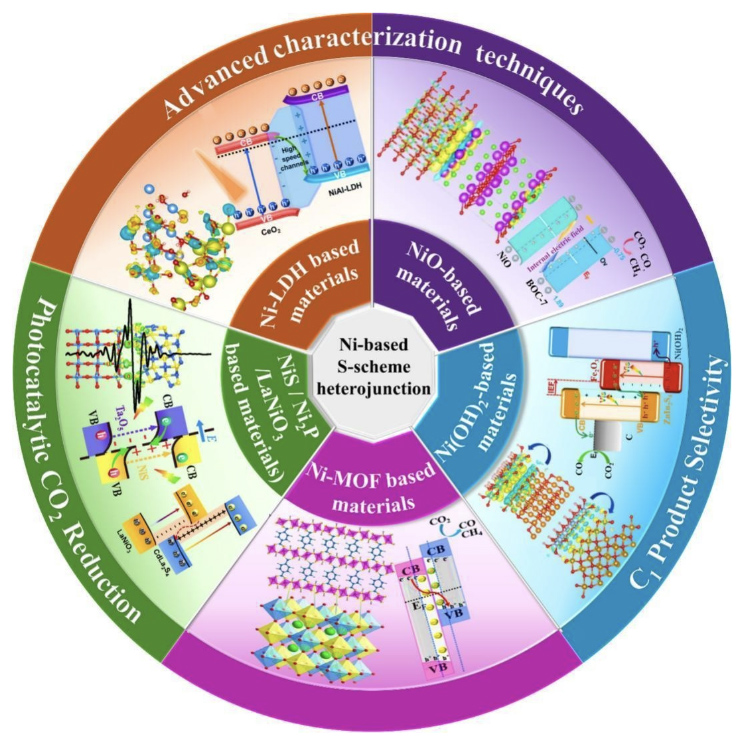
Overview of Ni-based S-scheme heterojunctions for photocatalytic CO₂ reduction with enhanced C₁ product selectivity.
Major Contributions
1.Ni-based S-scheme heterojunctions enhance photocatalytic CO₂ reduction by promoting effective charge separation, reducing recombination, and maintaining strong redox potentials, achieving high selectivity toward C1 products (CO, CH₄).
2.Advanced spectroscopic and theoretical analyses, including DFT, KPFM, ISI-XPS, and operando techniques, provide detailed insights into interfacial charge transfer dynamics and the role of Ni coordination in boosting catalytic activity.
3.The review identifies critical future directions for Ni-based S-scheme systems, including expansion to multi-carbon products, AI-assisted catalyst design, broader energy and sensing applications, and precise structural and electronic engineering to optimize performance.
主要貢獻
1.增強機制與高選擇性: 鎳基 S 型(S-scheme)異質結透過促進有效的電荷分離、減少載流子複合,並維持強氧化還原電位,從而增強光催化 CO₂ 還原效能,實現對 C1 產物(如 CO、CH₄)的高選擇性。
2.先進光譜與理論分析: 結合 DFT(密度泛函理論)、KPFM(凱爾文探針力顯微鏡)、ISI-XPS(原位光照 XPS)以及 Operando(操作中/原位)技術,提供了關於界面電荷轉移動力學及鎳配位在提升催化活性中關鍵作用的詳細見解。
3.未來發展方向: 本綜述確立了鎳基 S 型系統的關鍵未來方向,包括擴展至多碳(C2+)產物的合成、AI 輔助催化劑設計、更廣泛的能源與感測應用,以及透過精確的結構與電子工程來優化性能。