
Anode-Free Batteries: Pioneering Energy Storage Revolution
▌Anode-Free Batteries: Pioneering Energy Storage Revolution
無陽極電池:開創能源儲存革命
Bibliographic Data 書目資料
| Authors 作者 |
Yosef Nikodimos*, Kassie Nigus Shitaw, Teklay Mezgebe Hagos, Tsung-I Yeh, Yu-Chun Huang, Chia-Lung Hsieh, Hsuan-Hsuan Su, Wei-Nien Su*, Bing Joe Hwang* |
|---|---|
| Corresponding author(s) 通訊作者 |
Yosef Nikodimos; Wei-Nien Su; Bing Joe Hwang |
| Journal 期刊 |
Chemical Reviews (Chem. Rev.) |
| Year 年份 |
2026 |
| Volume / Issue / Article 卷/期/文章編號 |
Vol. 126, Issue 4, pp. 2391–2483 (93 pages) |
| DOI | https://doi.org/10.1021/acs.chemrev.5c00533 |
| Keywords 關鍵字 |
Anode-free batteries; metal plating/stripping; dead lithium; Coulombic efficiency; Li/Na/K/Zn/Mg/Al; all-solid-state batteries (No author keywords listed; terms drawn from the abstract.) |
| SEED Member SEED 成員 |
Wei-Nien Su 蘇威年 Bing Joe Hwang 黃炳照 |
Summary 摘要
English
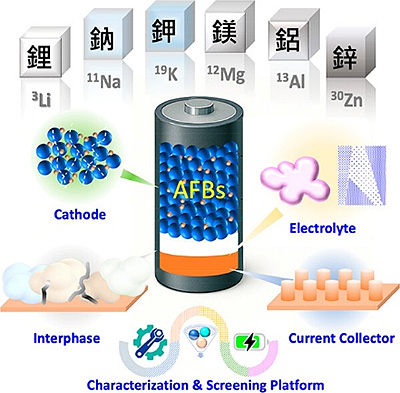
This comprehensive review examines anode-free batteries (AFBs), which eliminate the pre-loaded anode to raise energy density, improve safety and simplify manufacturing. It analyzes the fundamental phenomena of metal plating and stripping: nucleation and growth, dendrite formation, electrolyte decomposition with SEI fracture, dead-metal formation and regeneration, and contact loss from the current collector. Key performance parameters, including Coulombic efficiency, electrolyte-to-cathode ratio, external pressure, and formation and cycling protocols, are evaluated. The review extends beyond lithium to anode-free sodium, potassium, zinc, magnesium, aluminum, sulfur and all-solid-state systems, highlighting each system's specific challenges and solutions. It also positions AFBs as a diagnostic platform for visualizing metal deposition, quantifying dead metal, determining irreversible Coulombic efficiency and rapidly screening electrolytes. It closes with perspectives on the remaining challenges (limited metal inventory, unstable plating/stripping, cathode degradation, electrolyte instability and cross-talk) and on directions toward practical deployment.
中文
本篇綜合性回顧論文探討無陽極電池(AFB)。此類電池省去預先置入的陽極,可提升能量密度、改善安全性並簡化製程。文中系統分析金屬沉積與剝離的基礎現象,包括成核與成長、枝晶形成、伴隨SEI破裂的電解液分解、死金屬的生成與再生,以及金屬與集電器之間的接觸失效。作者評估影響性能的關鍵參數,如庫倫效率、電解液與正極比(E:C ratio)、外加壓力以及化成與循環條件。討論範圍並由鋰延伸至無陽極鈉、鉀、鋅、鎂、鋁、硫及全固態電池,說明各體系特有的挑戰與對策。此外,本文強調AFB可作為研究平台,用於觀測金屬沉積、量化死金屬、測定不可逆庫倫效率及快速篩選電解液。最後,作者針對金屬存量有限、沉積/剝離不穩定、正極劣化、電解液不穩定與交互干擾等挑戰,提出邁向實用化的未來研究方向。
Major Contributions
1. Provides a unified mechanistic picture of anode-free operation: nucleation and growth dynamics, plated-metal morphology, SEI fracture, metal-inventory loss, dead-metal formation and regeneration, and heterogeneity, compared across different metals.
2. Establishes a framework of critical parameters (Coulombic efficiency, E:C ratio, external pressure, formation and cycling protocols) that links cell design to cycle life and energy density, covering Li, Na, K, Zn, Mg, Al, S and all-solid-state anode-free systems.
3. Positions AFBs as a research tool (visualizing plating, quantifying dead metal, measuring irreversible CE, screening electrolytes) and sets out a roadmap of challenges and strategies toward commercialization.
主要貢獻
1. 建立無陽極電池運作的統一機制圖像,涵蓋成核與成長動力學、沉積金屬形貌、SEI破裂、金屬存量損失、死金屬生成與再生及不均勻性,並比較不同金屬的特性。
2. 提出關鍵參數架構(庫倫效率、E:C比、外加壓力、化成與循環條件),連結電池設計與循環壽命及能量密度,範圍涵蓋鋰、鈉、鉀、鋅、鎂、鋁、硫及全固態無陽極體系。
3. 將無陽極電池定位為研究工具(觀測沉積、量化死金屬、測定不可逆庫倫效率、篩選電解液),並提出邁向商業化的挑戰與策略藍圖。