
▌Configurational entropy–induced lattice distortion in high-entropy Prussian blue analogues derived transition metal phosphide accelerates electrocatalytic hydrogen evolution in alkaline media
高熵普魯士藍類似物衍生過渡金屬磷化物中組態熵誘導晶格畸變加速鹼性電催化析氫
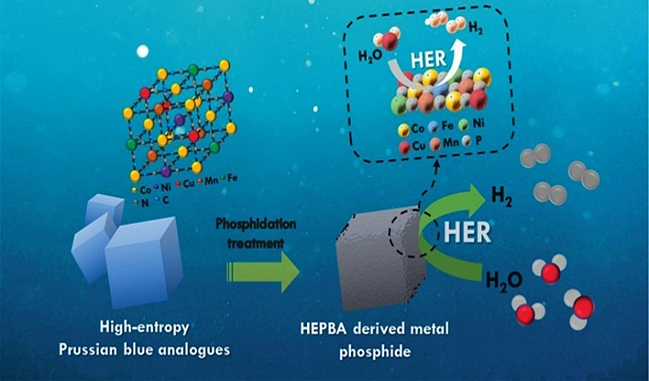
Major Contributions
1. High-entropy Prussian blue analogue (HE-PBA) precursors are converted to transition metal phosphides (TMPs) retaining configurational entropy-induced lattice distortion, generating high-density active sites with optimized electronic structure for alkaline HER.
2. Lattice distortion from configurational entropy in HE-TMPs modifies the local coordination environment and fine-tunes hydrogen adsorption free energy toward near-optimal catalytic activity, outperforming low-entropy reference catalysts.
3. The HE-TMP catalyst achieves superior long-term alkaline HER stability attributed to thermodynamic stabilization from high configurational entropy, providing a generalizable high-entropy design strategy for electrocatalyst development.
主要貢獻
1. 高熵普魯士藍類似物(HE-PBA)前驅體轉化為保留組態熵誘導晶格畸變的過渡金屬磷化物(TMP),生成具有優化電子結構的高密度活性位點用於鹼性 HER。
2. HE-TMP 中組態熵引起的晶格畸變調節局域配位環境,將氫吸附自由能精確調至接近最佳催化活性,優於低熵對照催化劑。
3. HE-TMP 催化劑展現卓越的鹼性 HER 長期穩定性,歸因於高組態熵的熱力學穩定化效應,為電催化劑開發提供可推廣的高熵設計策略。